
Marshall County Projected and Actual Release Dates
A projected date is a working sentence calculation. An actual release date records when custody ended or changed. The two may match, but they serve different purposes. ODOC calls its calculation tentative because earned-credit level, misconduct, achievement credits, court orders, and other legal limits can change the time left. A projected date also does not state whether the person will leave for the community, begin parole, or transfer to another authority.
Marshall County Jail custody requires a separate local analysis. A person held before trial may leave on bond, after dismissal, under a court order, or upon transfer. None is a fixed sentence-based date in advance. Someone serving a purely county-jail sentence may have a local release calculation, but the reviewed Marshall County sources publish no online formula, release schedule, or future-date field. Ask jail administration and compare the answer with the District Court judgment. If the person was sentenced to ODOC but is waiting in the county jail for transport, the state framework may apply after recognized jail credit.
Leaving the Marshall County building is not always release. A transfer to ODOC, another county, or another custodian ends one jail episode while custody continues elsewhere. The releasing or destination field in the sheriff record resolves that difference.
Marshall County Future Release Dates Are Confidential
The ODOC Offender Info page states that an inmate's exact release date is confidential unless the requester demonstrates a legitimate need, such as a judicial or law-enforcement need. The inmate receives the number of days remaining at the end of each month. A facility correctional records officer or case manager can help the inmate understand the calculation, and the inmate may choose to share it.
This access limit changes how the public OK Offender Basic Search should be described. Its inputs are DOC number, first name, last name, and date of birth, with options for aliases and similar-sounding names. It can help confirm identity, current status, location, community supervision, or a historical release indication. It is not a public Marshall County projected-release-date calculator. ODOC also warns that its public data is abbreviated and does not give an exact explanation of sentence details or time to be served.
ODOC's own explanation is the controlling source for this limit. Read the agency's release-date and offender-information guidance before relying on a search result.
The official page distinguishes a confidential, tentative future calculation from the public information that can support a later release or status check.
Note: Victims seeking information about a particular ODOC inmate may contact Victim Services at 405-425-2607 or victim.services@doc.ok.gov.
Find a Marshall County Projected Release Date
First identify the custody system. The county jail, ODOC, and federal authorities do not share one date calculator. A Marshall County arrest alone does not establish an ODOC sentence. Likewise, a person missing from the live local custody channel may have bonded out, transferred, or moved into state custody. Use records from the agency that holds or sentenced the person.
- Confirm identity and present custodian. Search OK Offender by DOC number when known, or by full name and date of birth.
- For a pretrial or county-sentenced detainee, contact Marshall County Jail administration and check the District Court docket. Ask whether the person has a sentence, bond event, order, or hold.
- For an ODOC prisoner, treat the public status as a lead only. The inmate's monthly statement and authorized facility records staff provide the current calculation.
- Check the judgment for consecutive sentences, credited jail time, and the conviction statute. These can change the estimate or impose a floor.
- After release, request the sheriff or ODOC record that states the actual event, date, type, and destination where releasable.
The public ODOC search fields are useful for the first identity check. Open the official OK Offender search rather than a same-named third-party source.
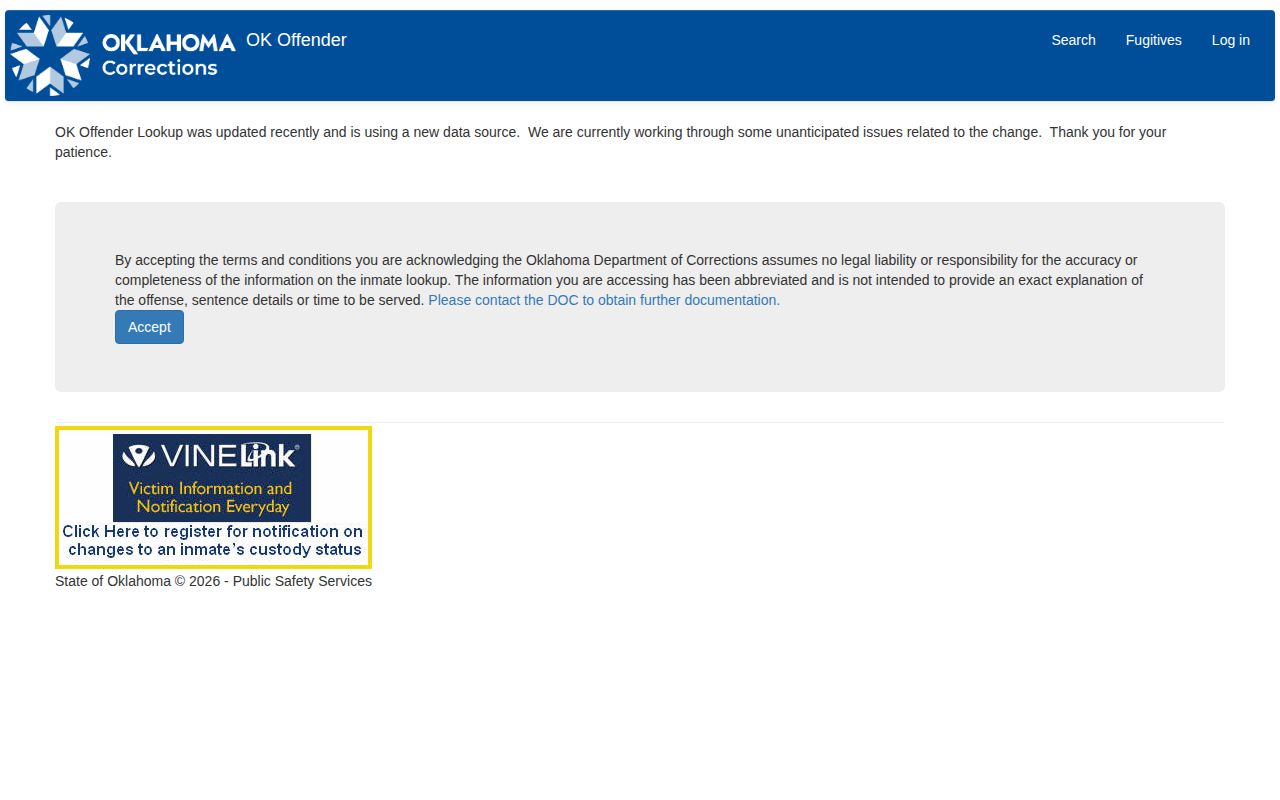
Those fields help locate the correct state record, but they do not turn the result into a certified release record or disclose the confidential exact future date.
For a named local booking, the Marshall County release-record and released-inmate search path explains how to obtain the sheriff record. That record is the right source for a completed county release. It should not be used to calculate a state prison term.
Marshall County Release Credits Under Section 138
Oklahoma's state-prison earned-credit framework appears in 57 O.S. § 138. Except where another law controls, credits reduce a state-institution term each month according to the person's class level. One earned credit equals one day of incarceration. Credits can be lost after misconduct and due process. They may be restored under ODOC rules. Life sentences receive no earned-credit deduction, and the statute contains other exclusions.
Section 138 provides two class schedules. A person who has ever had a qualifying felony under subsection E receives 0 days per month in Class 1, 22 in Class 2, 33 in Class 3, and 44 in Class 4. A person without that qualifying felony history receives 0, 22, 45, or 60 days per month at the same four levels. Class assignment can change with conduct and program participation. Subsection H also allows achievement credits for approved education, work, treatment, or other accomplishments, subject to loss and restoration.
| Class | Qualifying felony history | No qualifying felony history |
|---|---|---|
| Class 1 | 0 days per month | 0 days per month |
| Class 2 | 22 days per month | 22 days per month |
| Class 3 | 33 days per month | 45 days per month |
| Class 4 | 44 days per month | 60 days per month |
Subsection I requires the accumulated time to be tallied monthly and given to the inmate. That monthly total, not a one-time public estimate, reflects class changes and later credits. Subsection G also addresses qualifying jail time served before transport on an ODOC judgment and people held in county jail while waiting for ODOC reception due to scheduling. It does not apply the ODOC class formula to every purely county-jail sentence.
Note: Section 138 governs the state-prison credit calculation described here; Marshall County publishes no separate online county-jail good-time formula.
Marshall County Release Dates and 85% Rule
Oklahoma's “85% rule” is offense-specific. It is not a universal rule for every felony or every Marshall County sentence. 21 O.S. §§ 12.1 and 13.1 require people convicted of listed offenses to serve at least 85% of the imposed term before parole consideration. Earned credits cannot reduce imprisonment below that floor.
Section 13.1 contains the offense list. It includes specified homicide, sex, robbery, child-abuse, aggravated-trafficking, and human-trafficking crimes. The conviction statute and offense date must be checked. A short charge label on a public docket is not enough to apply the rule. Amendments, final disposition, and the judgment can matter, so arithmetic based only on the arrest charge can be wrong.
Parole eligibility is also not a release promise. Eligibility means the earliest lawful point at which consideration may occur after all applicable limits. The Pardon and Parole Board may have further process, and ODOC must complete its own release work. For offenses outside the listed group, other sentence rules still control. Consecutive terms, court orders, credits, and discipline can all affect the working date.
Why Marshall County Projected Release Dates Change
A tentative date moves when one of its legal or administrative inputs changes. Some changes reduce time. Others add time or prevent physical release even after one sentence reaches its calculated end. The underlying record should identify which event occurred instead of treating every delay as lost good time.
| Factor | Possible effect | Best confirming source |
|---|---|---|
| Class-level change | Changes the monthly credit rate | Inmate monthly time statement or ODOC records staff |
| Achievement credit | May reduce remaining time when authorized | ODOC calculation and program record |
| Misconduct | May cause credit loss after required process | ODOC disciplinary and sentence records |
| Detainer or hold | May prevent community release or cause transfer | Holding agency and release/destination record |
| Court order | May amend, revoke, or otherwise change the term | Marshall County District Court docket and order |
| Parole action | May permit supervised release but not guarantee the exit date | PPB result plus later ODOC status |
| Consecutive sentence | Requires one term to follow another under the judgment | Judgment, sentence administration, and ODOC calculation |
A detainer is a request or notice from another authority concerning custody. It can mean someone leaves the Marshall County Jail but enters another agency's control. That is a transfer, not a community release. Parole works differently: a favorable Board action can permit supervised release, yet processing and conditions may remain before physical departure.
Confirm Marshall County Actual Release
Once release may be near, use notification as an alert and the agency record as proof. VINELink may provide a custody-change notice when the participating agency supplies the event. It is not a sentence calculator, and a missing result does not prove continued custody or release. The Marshall County VINELink check explains how to search one person and register for an available alert.
After a county-jail event, ask the Marshall County Sheriff's Office for the booking and release record. Request the release date and time, recorded release or disposition code, releasing authority, and transfer or destination field where releasable. Compare it with the court docket, since the docket may explain bond, dismissal, or sentence but usually not the exact moment jail staff completed release.
After an ODOC event, read the public status in context and seek nonconfidential historical discharge documentation when needed. A community-supervision status means the person is outside secure prison custody but may still be on parole or probation. A discharge indication is stronger evidence that the state term ended. In every system, the actual record created after the event is more reliable than an earlier projection.
Note: Confirm whether the person entered the community or another agency's custody; both can remove a name from the prior facility.